



Whether you’re counting down to the next PSA exam on 23rd April or just starting your PSA preparation, understanding the structure of the Prescribing Safety Assessment is key to good planning. Our guide breaks down all eight sections of the PSA, helping you understand what’s expected and where to focus your revision efforts.
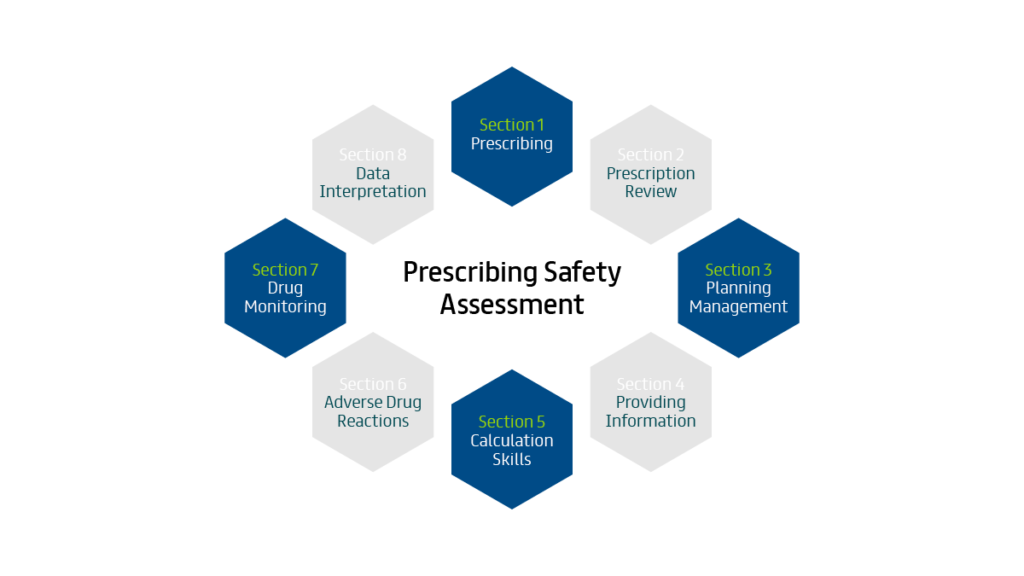

The PSA is a two-hour online assessment that tests your prescribing competence across 60 questions, worth a total of 200 marks. Each section assesses different prescribing skills, from writing prescriptions to calculating drug doses and recognising adverse reactions. Let’s explore what each section involves and how you can approach them with confidence.
1. Prescribing
8 questions, 10 marks each (80 marks total)
This is the largest section of the PSA, accounting for 40% of the total marks. You will be given clinical scenarios and asked to write complete, accurate prescriptions using a digital prescribing interface.
What’s being tested:
- Selecting the correct medicine for the indication
- Prescribing the correct dose, route and frequency
- Managing acute and routine clinical situations safely
Top tip: Always consider patient-specific factors such as age, weight, renal function and allergies. Use the formulary provided within the exam platform to confirm doses and prescribing advice.
2. Prescription Review
8 questions, 4 marks each (32 marks total)
You will review prescriptions written by others and identify errors or issues that could cause harm.
What’s being tested:
- Systematic review of prescriptions
- Identification of prescribing errors and omissions
- Recognition of clinically significant interactions or contraindications
Top tip: Review each medicine methodically, checking indication, dose, route, frequency and interactions.
3. Planning Management
8 questions, 2 marks each (16 marks total)
You will choose the most appropriate management option from five possible responses.
What’s being tested:
- Clinical judgement
- Knowledge of first-line management
- Recognition of when treatment may be inappropriate or unsafe
Top tip: Use the treatment summaries in the formulary provided and become familiar with where common conditions are located.
4. Providing Information
6 questions, 2 marks each (12 marks total)
This section focuses on communicating key information about medicines to patients.
What’s being tested:
- Prioritising important safety information
- Understanding what patients need to know to use medicines safely
- Communicating effectively about high-risk and commonly prescribed medicines
Top tip: Focus on information that prevents harm, such as monitoring requirements or serious side effects.
5. Calculation Skills
8 questions, 2 marks each (16 marks total)
You will perform drug calculations and enter the correct final answer.
What’s being tested:
- Accuracy in dose and rate calculations
- Understanding dose adjustments
- Correct interpretation of calculation scenarios
Top tip: Work calculations out carefully before entering your final answer and always sense-check the result.
6. Adverse Drug Reactions
8 questions, 2 marks each (16 marks total)
This section tests your ability to recognise and respond appropriately to adverse drug reactions.
What’s being tested:
- Recognition of common and serious adverse reactions
- Understanding which medicines are associated with specific risks
- Appropriate action when an adverse reaction occurs
Top tip: Focus on well-established, high-yield adverse reactions linked to commonly prescribed medicines.
7. Drug Monitoring
6 questions, 2 marks each (12 marks total)
Some medicines require monitoring to ensure they are effective and safe.
What’s being tested:
- Knowing what to monitor and when
- Interpreting abnormal results
- Assessing whether treatment should be continued, adjusted or stopped
Top tip: Be clear on monitoring intervals and what abnormal results may indicate.
8. Data Interpretation
6 questions, 2 marks each (12 marks total)
You will interpret clinical data and decide how it affects prescribing.
What’s being tested:
- Interpretation of laboratory and investigation results
- Recognition of when dose adjustments are needed
- Understanding how data influences safe prescribing decisions
Top tip: Identify abnormal values and consider their clinical significance.
Sitting your PSA exam with confidence
Breaking down revision for the PSA exam into its component sections makes it far more manageable. Each section tests specific, learnable skills. With structured preparation, strategic time management and thorough practice you’ll be well equipped to demonstrate your prescribing competence.
Remember that the BPS Assessment Learner Portal offers free PSA Prep eLearning sessions covering each section in detail, addressing common challenges like time pressure, calculations and identifying key clinical details. These resources, combined with practice papers and your clinical knowledge will help you to succeed in your exam.