Prescribing Safety Progress in 2025

As we look forward to another year of supporting learners across the UK and beyond to become confident, safe prescribers, we’re taking a moment to celebrate the BPS Assessment community and reflect on the growth and achievements of 2025.

The BPS Assessment Hub is our innovative digital learning and assessment platform designed to build competence in prescribing and promote safer practice. In a world where prescribing errors remain a significant patient safety challenge, well-structured learning and reliable assessment tools are critical. The Hub promotes safer prescribing practices by offering expert-led resources for learners to deepen their understanding of safe prescribing principles.

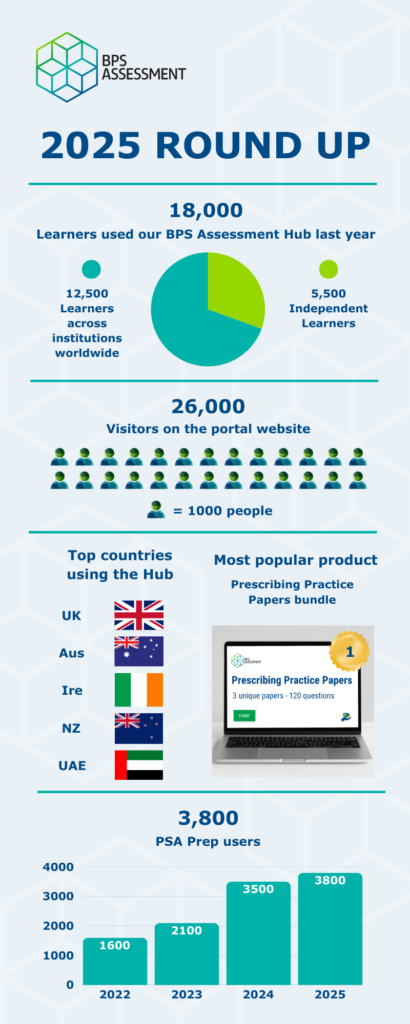
In 2025, our website welcomed over 26,000 users, reflecting continued confidence from learners and educators worldwide in our resources. 18,000 learners actively engaged with our assessments and practice tools to sharpen their prescribing skills.

Whilst our resources are developed in line with UK clinical guidance, including the British National Formulary (BNF), our reach stretches beyond borders. Alongside strong engagement from learners across the UK, users visited The Hub from Australia, Ireland, New Zealand, the United Arab Emirates, and beyond, showing the global demand for high-quality prescribing support.

Our Prescribing Papers Bundle was the most purchased product, combining our three unique Practice Papers for a discounted price. This popular bundle includes 120 questions, a 60-item mock exam, detailed feedback, and answer justifications, and has been produced by UK experts in line with current clinical standards.

We were pleased to see 3,800 learners take advantage of PSA Prep, our suite of free practice resources designed for those preparing for the Prescribing Safety Assessment. Covering everything from exam format and time-management strategies to key topic areas, PSA Prep equips learners with foundational knowledge and confidence before they sit their assessment.

These milestones reflect a shared commitment across the prescribing community to safer, more effective practice. As BPS Assessment continues to grow and lead the way to safer prescribing, we remain dedicated to improving and innovating our platform, and broadening access to high-quality resources that support current and future prescribers.

What to Do If You’ve Failed Your PSA in 2026

Failing the Prescribing Safety Assessment can feel disheartening. You’ve put in work, sat the exam and not received the results you were hoping for. Feeling worried about what comes next is completely understandable.

A significant number of students don’t pass the PSA on their first attempt. The great news is you’ll get another opportunity to sit the exam. How you approach your resit is important, focusing your efforts by working out what went wrong and using your first attempt as valuable experience can be a good place to start.

Work out what went wrong

Before jumping back into revision, you need to understand why you didn’t pass. Ask yourself, Which question types caused the most problems? Prescribing, calculations, adverse drug reactions, planning management? Did you run out of time? Which sections took longer than expected? Were you confident using the BNF, or did you waste time searching for information?

If your medical school provides feedback, go through it carefully. Understanding your weak spots is the first step to fixing them.

Build a revision plan

Making a clear revision plan will prevent you from repeating the same mistakes if you use a structured approach that targets your weak areas.

Set specific goals and rather than ‘revise prescribing’, aim for something concrete like ‘complete the Prescribing PSA Prep session and do 20 practice questions’.

Focus on your weaknesses, for example if calculations were the problem, spend more time there. If you struggled with adverse reactions, make that a priority.

Remember to learn from the practice questions. Don’t just check your answers. Understand why the right answer is right and why the wrong ones are wrong.

Use exam conditions to time yourself, use the BNF and practise the full two hours. The more familiar it feels, the better you’ll perform.

Time management

Running out of time is one of the main reasons students fail the PSA. Two hours goes quickly when you’re navigating the BNF and working through clinical scenarios. Practise under timed conditions and stick to it. If you’re spending ten minutes on a question that should take three, you’ll struggle in the real exam. Use the flag and return method. If a question is taking too long, flag it and come back later. Get quicker with calculations and BNF navigation. The faster you can find information and work through calculations, the more time you have for everything else.

Master the BNF

The BNF is your most important tool in the PSA. If you’re not confident using it, you’re at a disadvantage. Know where to find what you need: indications, contraindications, dosages, interactions, side effects. Make sure you practise using the BNF whilst doing questions so you get used to looking things up under pressure.

Use the right resources

Focus on resources that actually target what’s in the exam.

PSA Prep eLearning sessions cover all eight prescribing domains and break down each question style. They’re free and designed specifically for the PSA.

Prescribing Practice Papers give you 120 questions with detailed feedback, including a full two-hour exam simulation.

Free knowledge checks on polypharmacy, antimicrobial prescribing and the Yellow Card scheme are also available on the BPS Assessment portal.

Access everything at https://portal.bpsassessment.com/ 

Look after yourself

Try to get enough sleep, eat properly and drink plenty of fluids, take breaks and talk to people if you need some support. Now you have exam experience and know exactly what needs work, you can approach your resit with a clear plan and the right resources which puts you in a much stronger position.

Good luck!