
Are you concerned about taking the PSA?

When it comes to the Prescribing Safety Assessment, it’s completely understandable to feel some pressure. The PSA is a high‑stakes exam, and for some students it can feel daunting, especially when balancing revision alongside placements, lectures, and everything else that comes with life at medical school.

The good news is that stress around the PSA is manageable, and much of it comes down to preparation and knowing what to expect.


Know the exam format

One of the quickest ways to reduce anxiety is to understand what you’ll be asked to do on the day. The PSA has a clear structure, and being familiar with it removes much of the uncertainty. Familiarise yourself with the eight question types, the timing, and what each section is assessing. When fewer things come as a surprise, you can focus your attention on answering the questions rather than worrying about the format.


Focus on the most important data

In the exam you’ll be presented with clinical information, and your task is to identify what is relevant to safe prescribing. Practising this skill during revision means you are less likely to spend valuable time on exam day working out where to focus. With practice, it becomes easier to pick out the key details quickly and confidently.


Use the BNF

The British National Formulary (BNF) is an essential resource for the PSA, and you’re allowed to use it during the exam. The key is knowing how to navigate it efficiently, so it supports your decision‑making rather than slowing you down. Regular use during preparation helps ensure it feels familiar on the day.


Remember your calculations and conversions

Drug calculations and unit conversions appear regularly in the PSA and can cause difficulty if they’re not well practised. Including these in your revision routine helps build confidence and reduces the risk of avoidable mistakes.


Get comfortable with time pressure

The PSA is a two‑hour exam with 60 questions, and time management is a common challenge. The time pressure reflects real clinical practice, where prescribing decisions often need to be made promptly and safely. Practising under timed conditions can help you develop a steady pace and improve confidence.


Look after yourself

This part is easy to overlook during revision, but it makes a real difference. Your wellbeing affects both learning and performance. Try to sleep well, eat regularly, and take breaks. If exam stress starts to feel unmanageable, it’s important to speak to someone you trust, such as a friend, tutor, or member of university support staff.


Make the most of what BPS Assessment has to offer

The BPS Assessment Hub is designed to support PSA preparation. Our resources cover all eight question types and provide detailed feedback to help you understand both correct answers and common errors. If you want to practise under exam‑style conditions, the 60‑item practice paper can be completed in a two‑hour sitting, with feedback to guide further revision. You can explore our eLearning, practice papers, and free resources here.

The PSA is challenging, but it is an assessment that many students pass each year with steady preparation. Taking a structured approach and making use of available resources can help you feel more prepared. Feeling nervous is common, and it often reflects how much the outcome matters to you.


Watch the video

The British Pharmacological Society has created a short video that covers many of these points in a clear, accessible way. It can be a helpful addition to your preparation.
https://www.youtube.com/watch?v=1dW7EuQJyog

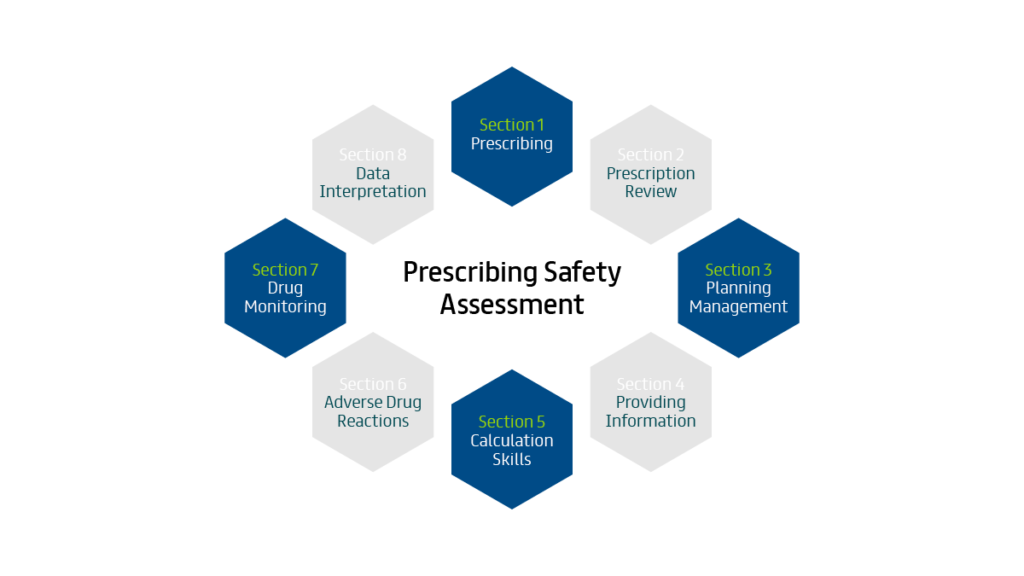
Quick guide to PSA exam sections

Whether you’re counting down to the next PSA exam on 23rd April or just starting your PSA preparation, understanding the structure of the Prescribing Safety Assessment is key to good planning. Our guide breaks down all eight sections of the PSA, helping you understand what’s expected and where to focus your revision efforts.

The PSA is a two-hour online assessment that tests your prescribing competence across 60 questions, worth a total of 200 marks. Each section assesses different prescribing skills, from writing prescriptions to calculating drug doses and recognising adverse reactions. Let’s explore what each section involves and how you can approach them with confidence. 


1. Prescribing

8 questions, 10 marks each (80 marks total)

This is the largest section of the PSA, accounting for 40% of the total marks. You will be given clinical scenarios and asked to write complete, accurate prescriptions using a digital prescribing interface.

What’s being tested:

  • Selecting the correct medicine for the indication
  • Prescribing the correct dose, route and frequency
  • Managing acute and routine clinical situations safely

Top tip: Always consider patient-specific factors such as age, weight, renal function and allergies. Use the formulary provided within the exam platform to confirm doses and prescribing advice.


2. Prescription Review

8 questions, 4 marks each (32 marks total)

You will review prescriptions written by others and identify errors or issues that could cause harm.

What’s being tested:

  • Systematic review of prescriptions
  • Identification of prescribing errors and omissions
  • Recognition of clinically significant interactions or contraindications

Top tip: Review each medicine methodically, checking indication, dose, route, frequency and interactions.


3. Planning Management

8 questions, 2 marks each (16 marks total)

You will choose the most appropriate management option from five possible responses.

What’s being tested:

  • Clinical judgement
  • Knowledge of first-line management
  • Recognition of when treatment may be inappropriate or unsafe

Top tip: Use the treatment summaries in the formulary provided and become familiar with where common conditions are located.


4. Providing Information

6 questions, 2 marks each (12 marks total)

This section focuses on communicating key information about medicines to patients.

What’s being tested:

  • Prioritising important safety information
  • Understanding what patients need to know to use medicines safely
  • Communicating effectively about high-risk and commonly prescribed medicines

Top tip: Focus on information that prevents harm, such as monitoring requirements or serious side effects.


5. Calculation Skills

8 questions, 2 marks each (16 marks total)

You will perform drug calculations and enter the correct final answer.

What’s being tested:

  • Accuracy in dose and rate calculations
  •  Understanding dose adjustments
  •  Correct interpretation of calculation scenarios

Top tip: Work calculations out carefully before entering your final answer and always sense-check the result.


6. Adverse Drug Reactions

8 questions, 2 marks each (16 marks total)

This section tests your ability to recognise and respond appropriately to adverse drug reactions.

What’s being tested:

  • Recognition of common and serious adverse reactions
  • Understanding which medicines are associated with specific risks
  • Appropriate action when an adverse reaction occurs

Top tip: Focus on well-established, high-yield adverse reactions linked to commonly prescribed medicines.


7. Drug Monitoring

6 questions, 2 marks each (12 marks total)

Some medicines require monitoring to ensure they are effective and safe.

What’s being tested:

  • Knowing what to monitor and when
  • Interpreting abnormal results
  • Assessing whether treatment should be continued, adjusted or stopped

Top tip: Be clear on monitoring intervals and what abnormal results may indicate.


8. Data Interpretation

6 questions, 2 marks each (12 marks total)

You will interpret clinical data and decide how it affects prescribing.

What’s being tested:

  • Interpretation of laboratory and investigation results
  •  Recognition of when dose adjustments are needed
  • Understanding how data influences safe prescribing decisions

Top tip: Identify abnormal values and consider their clinical significance.

Sitting your PSA exam with confidence

Breaking down revision for the PSA exam into its component sections makes it far more manageable. Each section tests specific, learnable skills. With structured preparation, strategic time management and thorough practice you’ll be well equipped to demonstrate your prescribing competence.

Remember that the BPS Assessment Learner Portal offers free PSA Prep eLearning sessions covering each section in detail, addressing common challenges like time pressure, calculations and identifying key clinical details. These resources, combined with practice papers and your clinical knowledge will help you to succeed in your exam.

Dark mode is now available on the eLearning portal

We’ve just added dark mode to the BPS Assessment eLearning portal

It is a small change, but if you do a lot of your revision in the evening it should make a noticeable difference. Staring at a bright white screen for hours is not great for your eyes, and dark mode softens the contrast enough to make those longer sessions a bit more comfortable. Less eye strain generally means fewer headaches and better concentration, which is worth something when you are working through a lot of prescribing content.

There are a couple of other upsides too. If you are studying on a laptop or tablet away from a charger, dark mode uses less battery on OLED and AMOLED screens, so you get a bit more time before you need to plug in. It also draws less power overall, which is a small but genuine environmental benefit.

Everything else works exactly as before and you can switch back to light mode any time you like. We’ve put together a short video showing where to find it and how to switch between modes.

Watch the video

Dark mode is available now across desktop and mobile, with nothing to download or update. If you have any questions, get in touch and we will help you out.

Preparing for the PSA on 23rd April?

If you’re settling in for a late night revision session ahead of the PSA exam this month, make sure you check out our free PSA Prep content. 

There are nine sessions designed specifically around the areas of the exam that candidates find most difficult, things like dealing with the time pressure, calculations and picking out the key points in clinical scenarios. Rather than covering the PSA broadly, each session goes deep on one question type so you come away knowing exactly how that part of the exam works, how it’s marked and how to approach it with a bit more confidence. Access them all here